Janam XT4
Next evolution of Janam's smartphone-style rugged Android touch computer
(by Conrad H. Blickenstorfer)
In June 2025, Janam introduced the Janam XT4. The new model represents an evolved and refined version of the concept and ultra-rugged design of Janam's best-selling XT3, but adds state-of-the-art processing, wireless communication and data capture technologies to rise to new levels of productivity and efficiency. Android 14 GMS and Android Enterprise Recommended certification make the XT4 comply with demanding enterprise requirements.
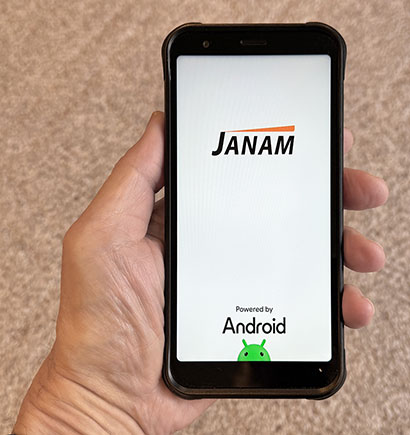
Janam's highly regarded XT Series started a number of years ago. With smartphones selling by the billions, Janam realized that many enterprise customers were looking for handhelds that combined cutting-edge smartphone technologies with mission-critical enterprise features and security.
Janam initially addressed that need with their original XT1 rugged mini-tablet, followed a couple of years later with the XT2 that supported both Windows 10 IoT Mobile Enterprise and Android. A slightly updated Android-only XT2+ version followed. Then, in 2020, came the XT3 with many hardware and software upgrades and enhancements. And now we have the XT4, a thoroughly modern rugged handheld that can more than hold its own against any competition.
The challenge of creating a mobile computing tool for the job that also pretty much looks and feels like a modern phone is to really pull it off. If a device looks like a state-of-the-art smartphone but can't back up the look with the advanced specs and tech consumers expect, it'll quickly be dismissed. If it does deliver but is just too big and heavy, again, it won't go far. So the challenge is to come up with something that has that appealing consumer tech look and feel, but also adds enough serious tool-for-the-job value to make enterprise users accept a bit of extra extra heft in exchange for features and durability.
The Janam XT4
So let's take a look at the new Janam XT4. It has a 6.15 x 3.14 inch footprint, which is almost exactly that of a modern smartphone. How is that possible with the tough-looking protective perimeter armor and corner guards that fragile consumer phones don't have? It's because the XT4's 6.0-inch display is a tad smaller than what you'd find in standard smartphones with their beautiful but fragile edge-to-edge screens.
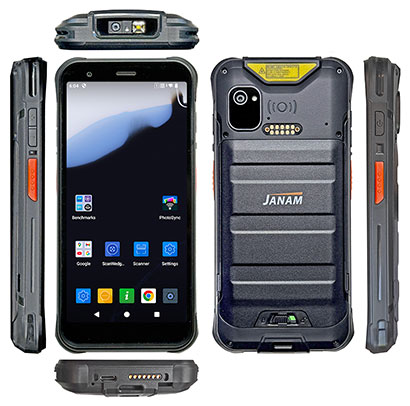
While the XT4 looks just like a tougher, better protected smartphone from the front, it has the kind of connectivity and data collection technology only professional gear can provide.
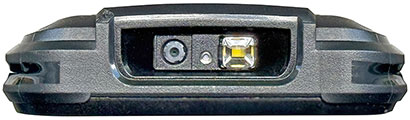
The XT4 includes, for example, an integrated industrial-grade Honeywell N5703 1D/2D barcode reader. That's because on the job you don't scan inventory with the phone camera and a potentially flaky app. You do it with tech that was designed for fast, reliable scanning.
As far as ruggedness goes, the XT4's specs really don't tell the whole story. It is IP67-sealed (dust- and waterproof) and has a 5-foot drop specs. Leading smartphones are often IP68-sealed these days, and can handle enormous drops in the cheap cases virtually every gleaming new consumer phone is immediately put it right upon purchase. But look at all the consumer phones that still break, because they are simply too flimsy. The XT4 won't break. In addition, the -4° to 140° Fahrenheit operating temperature range means the XT4 can be used just about anywhere. And it doesn't mind severe vibration and getting rattled around either.
Unlike consumer smartphones, the XT4 has a big, hot-swappable, replaceable battery. So no need to constantly watch the remaining battery charge. If there's no charge left, simply pop in a fully charged spare. As a result, the XT4 is 0.7 inches thick and weighs a bit over ten ounces. That is thicker and heavier than a consumer phone, but still amazingly thin and light for a rugged enterprise-class handheld computer.
What's new and improved
Compared to its XT3 predecessor, the XT4 comes with significantly more powerful hardware. Under the hood, a 2.7GHz octa-core Qualcomm SD660 replaces the older 2.2GHz octa-core Qualcomm SD660. Based on our XT4 benchmarks, the new model should be two to three times quicker than the XT3. That's huge performance improvement. Specifically, we saw scores of 9,632 on PCMark for Android, 926 on AI Benchmark 6, 3,072 on 3D Mark for Android, 510,091 in AnTuTu, and 14,301 in PassMark Mobile. Those are all excellent scores for this class of device.
Processing isn't the only thing that's been enhanced in the XT4. Instead of 64GB of onboard storage you get 128GB (plus what you put into the SDXC card slot). RAM has doubled from 4GB to 8GB. The front camera goes from 5 to 8 megapixel. The rear documentation camera goes from 13 to 16 megapixel. Wi-Fi, Bluetooth and mobile broadband are all much faster. Positioning now uses not only all four of the major satellite systems, but also has QZSS dual-band, A-GPS, XTRA support. That may mean faster fixes, higher accuracy,better reliability, and much better performance in urban canyons, forests, and other challenging spot.

On the software side, the XT4 jumps from the XT3's Android version 9 all the way to Android 14. This is as of mid-2025 the largest version in major use, and it's upgradeable all the way through Android 18. It is also "Android Enterprise Recommended." To qualify for this Google certification, a device must support multiple major operating system releases, deliver Android security updates within 90 days of release from Google for a minimum of five years, and must be protected against moisture and dust intrusion. In addition, the devices must offer bulk deployment options, including the Android zero-touch enrollment option for easy setup and configuration.
The XT4 has a larger, sharper and brighter display compared to the XT3. It now measures 6.1 inches diagonally, there is 575 nits of luminance, and the resolution jumps from 720 x 1280 pixels in the XT3 to a much nicer 1080 x 2160 pixels. That easily makes the screen sharp enough even for apps such as GIS, positioning, and all sorts of advanced graphics applications. The XT3's four user-facing hardware keys, though, are gone, and some will miss them. But the XT4 still has hardware buttons for volume up/down and two for scanning. All of those can be programmed.
Fully state-of-the-art
What does all that make the Janam XT4? From its very start, Janam's XT series of rugged handhelds presented an attractive choice for enterprise-class smartphone-style Android-based handhelds with industrial durability and data collection technology. The new XT4 is the best one yet. In our testing it even beat its main rival, the Zebra TC27, in most tests. That's remarkable. — Conrad H. Blickenstorfer, August 2025